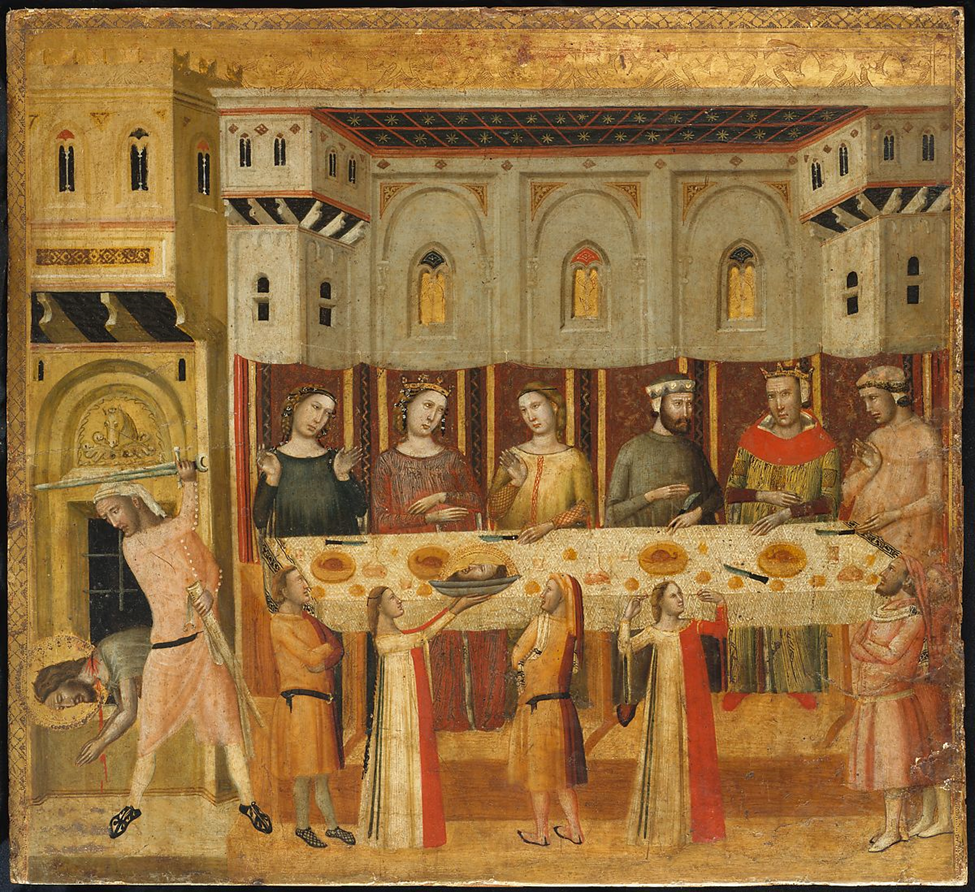
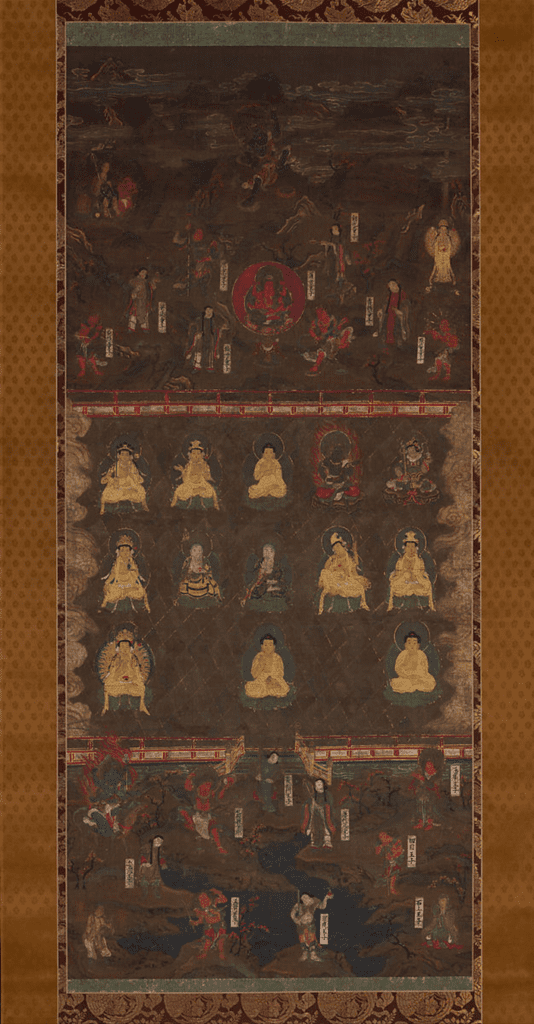
In many cultures, they represent bodies in very different ways. Here you see a work of art from Japan in the early 14th century, and an Italian piece from the same period. In the Japanese piece, the Kumano Shrine Mandala, made by an unknown artist in the Nanbokuchō period (1336–1392), it is representative of one of the most sacred sites in Japan, the Kumano Shrine complex. The bodies in the Japanese art are non-realistic, but I think that they were trying to be representational, not naturalistic. This piece is detailed in linework, but there is not a whole lot of shading and definition when it comes to shaping the bodies. Compared to the Japanese art, the Italian piece, The Feast of Herod and the Beheading of the Baptistca by Giovanni Baronzio in 1330–1335, seems a lot more realistic, but it is also specifically depicting humans and not a godly semi-humanistic being.
In Italy, at the time of the creation of Baronzio’s piece, they were stylizing work to downplay the feeling of realism and immersion in biblical art because of the religious society he was in. He painted the same person in different clothes 4 times, the others in the piece being different just because of the angle of their head or body. He does also portray the daughter in this piece, (woman in the red and white dress) as much smaller than the rest of the crowd due to the hierarchic scale. Those doing work for someone else, as a servant or slave, are often portrayed as much smaller than those they are serving. It shows her younger age as well as servitude as she is following her mothers wish to kill a man.
Now, there are some very big differences in material that will change how they represent bodies in this time as well. The Japanese were using ink, color, and gold on silk while the Italians used tempera on wood, with gold, and silver. The difference in material made it so that the Italian art, because of the consistency of the paint, could layer and mix colors. Although tempera dries quickly, it can still be mixed as well as create flat color. Because the Japanese piece is ink on fabric, they can mostly only do linework and basic washes, any detail outside of that could bleed due to the nature of fabric. All in all, these pieces are different for many reasons, but those reasons, written here, all come down to make their own style, specific to these artists, their country, and time.